You have read the pregnancy books. You have packed the hospital bag. You have set up the cot, washed the tiny onesies, and sat through the antenatal class. And then the hospital doors close behind you, and it is just you, your baby, and a silence that feels nothing like the peaceful scene you imagined. Most pregnancy content stops at the birth. Very little prepares you for what comes after, specifically the first four weeks that will simultaneously be the hardest and most significant of your life. Here’s what to expect in the first few weeks postpartum in Singapore.
Week One Postpartum
During pregnancy, your estrogen and progesterone levels reach extraordinary heights, higher than at any other point in your life. Within 24 to 72 hours of giving birth, both hormones drop dramatically.
Mental Health Status
A clinical review published in Psychiatric Clinics of North America [1] found that the abrupt and dramatic changes in hormone levels after delivery are a primary area of study when examining postpartum mood changes, particularly around progesterone, oestrogen, prolactin, and cortisol. The authors note that changes in certain hormonal patterns contribute to the depressive mood shifts some women experience following childbirth.
What this hormonal shift feels like in week one postpartum:
- Crying suddenly, without knowing why, is often described as waves that hit without warning
- Feeling strangely detached or emotionally numb for stretches of time
- Intense moments of love and connection, followed by moments of panic or overwhelm
- Night sweats as your body sheds pregnancy fluids
- Shaking or chills in the first 24 to 48 hours as hormones shift
Physical Status Nobody Describes Clearly
Beyond hormones, your body is also in physical recovery, and the reality is more intense than most birth preparation classes convey.
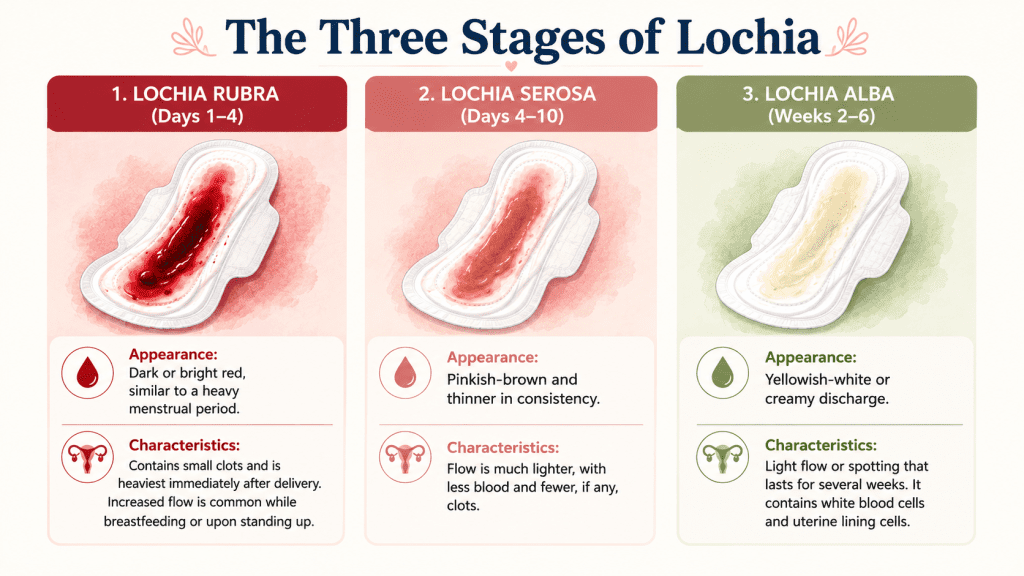
According to the Cleveland Clinic, [2] postpartum bleeding, known as lochia, is completely normal after both vaginal and caesarean deliveries. It contains blood, mucus, and tissue shed after childbirth, lasting 4 to 6 weeks. It starts heavy and bright red, then lightens to pink, brown, or yellow, gradually tapering off. Increased flow is common when waking or breastfeeding. This is your body clearing the uterine lining, a part of the postpartum healing process. Prepare with proper maternity pads, not regular period pads.
Other physical status of week one:
- Afterpains (postpartum cramping): It is a normal process of uterine involution, as your uterus contracts back to its pre-pregnancy size. You might experience additional pain while you are breastfeeding, since the oxytocin released during feeding actively speeds this process. But it will gradually ease the discomfort afterwards.
- Perineal or C-section recovery: Soreness, swelling, and tenderness around your wound site. SMG Women’s Health [3] notes that vaginal delivery recovery typically takes around six weeks, while C-section recovery can take up to 12 weeks.
- Breast engorgement: When your milk comes in between Day 2 and Day 5, your breasts can become very full and tender. It happens when breast tissue swells due to increased blood and fluid, along with the onset of mature milk.
- Sleep deprivation: A newborn feeds every two to three hours, which means you are woken eight to twelve times in 24 hours before your body has recovered from labour.
This is precisely the week when having a trained confinement nanny changes survival into recovery. Confinement Angels assigns nannies who handle night feeds, monitor your newborn’s cues, and allow you to rest in protected stretches, something no amount of preparation can fully replace.
A Note on Diastasis Recti: Something to Know Before You Start Exercising
During pregnancy, the growing belly places significant pressure on the abdominal wall. For many mothers, the muscles at the midline separate, a condition called Diastasis Recti. It is common, it varies in severity, and most women do not know they have it until they are already postpartum.
This matters because certain exercises you might instinctively attempt, including sit-ups, crunches, and planks, can worsen the separation if done before a proper assessment. According to Inspire Mum and Baby [7], a holistic wellness centre in Singapore, each Diastasis Recti session begins with a full consultation to understand the mother’s postnatal stage, delivery history, and any abdominal concerns, creating a plan that supports her specific healing needs.
Confinement Angels partners with Inspire Mum and Baby for Diastasis Recti assessment, which helps identify any abdominal separation (diastasis recti) post-pregnancy and provides personalised guidance on core rehabilitation and safe recovery strategies to help restore strength and function effectively.
Week Two: The Emotional Ambush
Baby Blues: What is Normal and What is Not
Baby blues affect a significant number of new mothers in the days immediately after birth. According to SingHealth [4], postnatal blues are as common as occurring in two-thirds of women, typically occurring in the first week after delivery. They are usually short-lasting and can resolve spontaneously within a few days to two weeks.
Symptoms include:
- Crying without a clear reason
- Irritability or mood swings that feel disproportionate to the situation
- Feeling overwhelmed by decisions that would normally feel simple
- Anxiety about whether you are doing things correctly
- A sense of loss of your identity, your body, or your previous life
Baby blues are driven by the hormonal drop described above.
However, if these feelings persist beyond two weeks, intensify rather than ease, or include thoughts of harming yourself or your baby, this may indicate Postpartum Depression (PPD). SingHealth [4] notes that ten to fifteen per cent of recently delivered women will develop postnatal depression, usually within the first three to six months after delivery. PPD is treatable. Speaking to your doctor is not an overreaction. It is the responsible step.
If you would like to find out the differences between postpartum depression and baby blues, read more:
Confinement Practices Across Cultures: What to Honour and What to Question
Singapore’s multicultural landscape means confinement looks different depending on your background. Every new mother is navigating not just her own physical recovery, but a set of cultural expectations that may or may not feel aligned with how she is actually feeling.
A study published in BMC Pregnancy and Childbirth [5] examined confinement practices among Chinese, Malay, and Indian mothers in Singapore and found significant differences in specific practices across the three groups, with dietary practices and rest patterns varying meaningfully by ethnicity.
| Chinese confinement | Malay confinement | Indian confinement |
| It traditionally emphasises rest, warming foods, avoidance of cold air and water, and herbal tonics designed to restore Qi and blood. TCM herbs and confinement meals play a central role in recovery. | It typically involves traditional herbs, Jamu herbal drinks, abdominal binding, and postnatal massage. Family involvement, particularly from the mother or mother-in-law, is culturally central to the process. | It often includes oil massages, warming foods, specific dietary practices, and strong extended family support structures. Practices vary considerably across Tamil, Malayalam, and other South Indian communities. |
Some traditional practices carry genuine physiological benefit. Rest, nutrition, and massage are all well-supported by evidence. Others are cultural beliefs that carry no harm but also no clinical basis. Knowing the difference gives you the confidence to honour your heritage without adding unnecessary guilt to an already demanding period.
Confinement Angels serves Chinese, Malay, and Indian families and assigns nannies who understand and adapt to each family’s cultural practices. A nanny who genuinely respects your household’s rhythms and traditions removes an entire layer of invisible stress.
Weeks Three and Four: The Turning Point
By the third week, the sharpest hormonal volatility begins to ease for most mothers. This does not mean everything suddenly becomes manageable, but there is often a subtle shift. Feeds become more predictable. You begin to read your baby’s cues. Sleep, while still fragmented, starts to feel slightly more organised.
This is also when you may experience the first genuine moments of competence. You handle something and realise you knew what to do. These moments matter. Hold onto them.
Breastfeeding is one of the most common sources of distress in the early postpartum period, and one of the most under-discussed. According to Mount Elizabeth [6], breastfeeding carries significant benefits for both mother and baby. For mothers, breastfeeding can help to protect against ovarian cancer and breast cancer. For babies, breast milk is gentle on the digestive system, with nutrients naturally designed to support their growth and development at every stage.
However, many mothers face real challenges in the early weeks that can affect both confidence and emotional well-being.
Common challenges of breastfeeding include:
- Latch difficulties that cause cracked or sore nipples
- Low supply anxiety, which is often unfounded but deeply distressing
- Engorgement, blocked ducts, and mastitis risk in the early weeks
- The time commitment, since a single feed can take 30 to 45 minutes in early postpartum
- Conflicting advice from family members, nurses, and online sources simultaneously
Breastfeeding can be beautiful and it can also be genuinely difficult. Both things can be true at the same time. If you are struggling, that is not failure. That is a skill that needs support to develop.
Confinement Angels works together with EMW TCM Clinic, to offer TCM Lactation Consultation as an add-on service. TCM approaches to lactation, including specific herbal formulas, dietary adjustments, and acupressure, can complement standard lactation support and address supply concerns from a different angle. Ask about available packages and current discounts when you enquire.
Your Body Beyond Week Four: When You Are Ready
At around six weeks, your doctor will typically conduct a postnatal check, examining your physical recovery, discussing contraception, and assessing your emotional wellbeing. This is a good time to raise any concerns you have been quietly carrying.
Many mothers also begin thinking about longer-term recovery during this period. When you feel ready, and only then, Confinement Angels offers RF Slimming as an complimentary partner service in the membership perks. Based on Tripolar RF and Dynamic Muscle Activation technology, the treatment targets localised fat, firms skin, and reduces the appearance of stretch marks. According to our partner, Cosmo Medical Spa, [8] it is suitable for all skin types and works well alongside postnatal massage as part of a broader recovery programme.
Remember, postpartum recovery is not a race. Your body has done something extraordinary, and it deserves patience before it is asked to perform.
What Confinement Angels Clients Say
Thank you for reading until here. Understanding that theory is useful, but real experience is more honest. Here is what families who have been through this actually say.
“We are so glad we went with Confinement Angels now that we are done with confinement. Our nanny assigned is so attentive and very good with the baby. As first-time parents, we are and would have been so lost if not for nanny’s help, and guidance to help us get the hang of things during the crucial early weeks,” said one of the first-time parents from Chinese family.
“The experience I had with my confinement nanny was nothing short of great. Kak Mimi is very caring, patient and meticulous when it comes to taking care of my second-born. Her baby handling skills are great. We all love her. Made many fond memories with her,” said second-time mother from Malay family.
“Having CA confinement nanny was a BLESSING! Aunty merged into our Indian family so seamlessly. She knows very well how to interact with every one in the family, our elder kids, our helper, and our grandparents. Everyone loved her and will miss her dearly,” said a third-time mother from Indian family.
Read more reviews from happy families here:
Every family is different. What does not change is how much the right support matters in those first weeks.
Confinement Angels provides confinement nanny services for Chinese, Malay, and Indian families across Singapore, with nannies who adapt to your cultural practices, your household dynamics, and your family’s specific needs. Contact Confinement Angels today by submitting the form after the article.
Medical Disclaimer
This article is for informational purposes only and does not constitute medical advice. Always consult your healthcare provider regarding your individual postpartum health, recovery timeline, and any symptoms that concern you, including signs of Postpartum Depression.
- Hendrick V, Altshuler LL, Suri R. Hormonal Changes in the Postpartum and Implications for Postpartum Depression. Psychiatric Clinics of North America. 1998;21(2):469-485. https://www.sciencedirect.com/science/article/pii/S0033318298713556
- Cleveland Clinic. Lochia. 2025. https://my.clevelandclinic.org/health/body/22485-lochia
- SMG Women’s Health. Post-Delivery Care: Recovery and Support. https://smgwomenshealth.sg/doctors-guide/pregnancy/post-delivery/
- SingHealth. Perinatal Depression. https://www.singhealth.com.sg/symptoms-treatments/perinatal-depression-mental-wellness
- Fok D, Aris IM, Ho J, Lim SB, Chua MC, Pang WW, Saw SM, Kwek K, Godfrey KM, Kramer MS, Chong YS; GUSTO Study Group. A Comparison of Practices During the Confinement Period among Chinese, Malay, and Indian Mothers in Singapore. Birth. 2016 Sep;43(3):247-54. doi: 10.1111/birt.12233. Epub 2016 Mar 27. PMID: 27018256; PMCID: PMC4992357. https://pmc.ncbi.nlm.nih.gov/articles/PMC4992357/
- Mount Elizabeth. Here’s Everything New Mums Need to Know About Breastfeeding. 2019. https://www.mountelizabeth.com.sg/health-plus/article/here-s-everything-new-mums-need-to-know-about-breastfeeding
- Inspire Mum and Baby. Diastasis Recti Support in Singapore. https://inspiremumbaby.com/postnatal/diastasis-recti/
- Cosmo Medical Spa. RF Slimming. https://cosmomedicalspa.sg/rf-slimming/